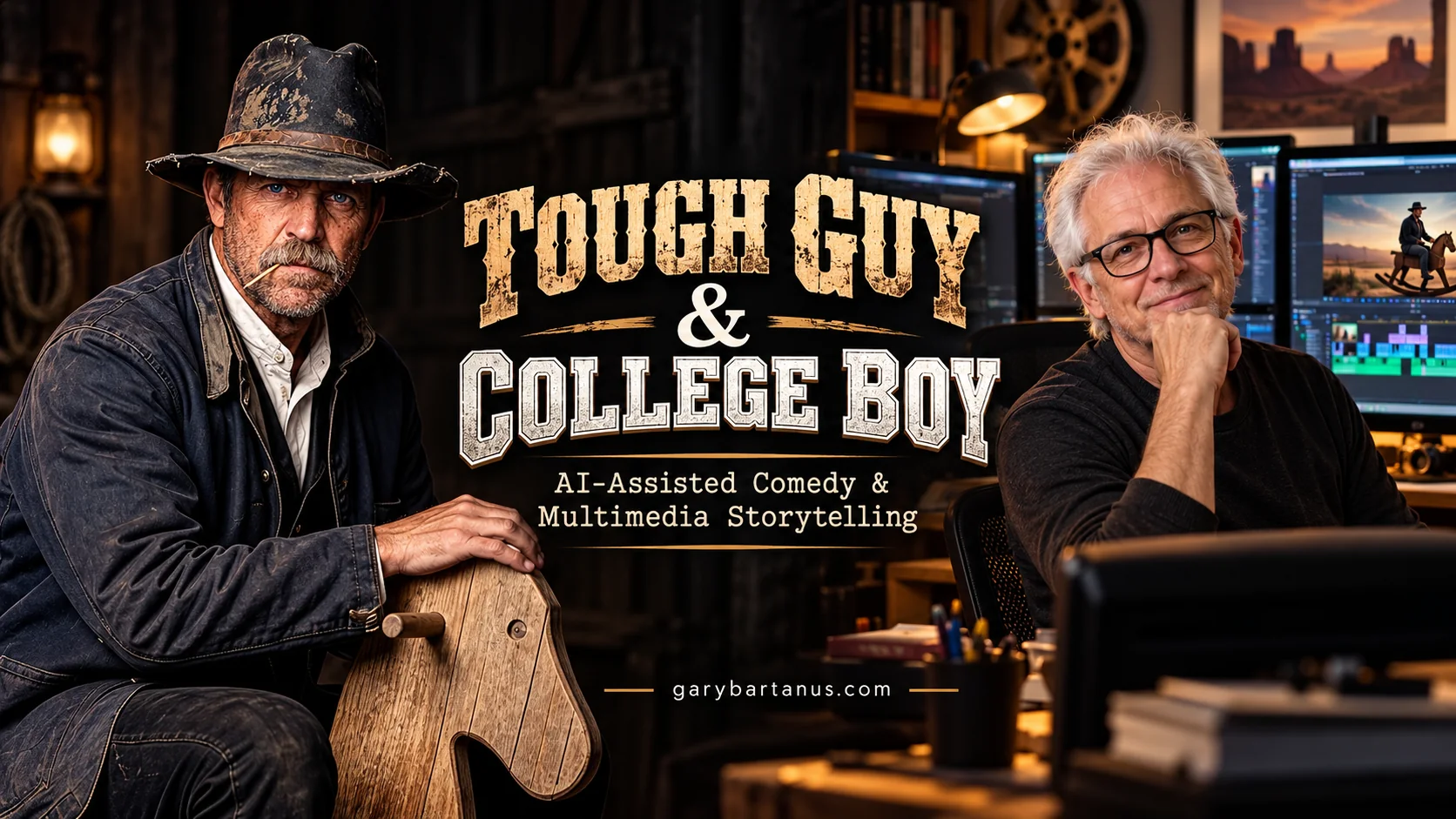
A Slap Shot Western · A teeny tiny bit north of the 49th
Two characters. Eight showdowns. One rather unruly experiment.
A comic Western that turns AI-assisted production, instructional design and technical mishaps into an ongoing argument between a stubborn cowboy and the fellow who made him.
Project type
AI-assisted micro-video series
My role
Concept · writing · direction · editing
Design focus
Attention · contrast · pacing · judgment
Status
Eight episodes · still evolving
Instructional-design purpose
Comedy is the artifact. The design decisions are the evidence.
Tough Guy & College Boy began as a creative AI-media experiment, but the series demonstrates transferable learning-design skills: audience awareness, message design, scripting, pacing, media selection, iteration, feedback, emotional tone, and purposeful use of AI rather than novelty for novelty’s sake.
The recurring pattern is simple: surface a misconception or overconfident assumption, create a moment of tension or surprise, then get out of the learner’s way.
One concrete learning use
A 12–15 second misconception reset
Imagine a cybersecurity module. Tough Guy dismisses multifactor authentication because “I already got a strong password.” College Boy gives one short response that exposes the flaw. The learner then moves immediately into the real explanation or practice activity.
Instructional function: surface the misconception, create cognitive tension, reset attention, then transition to learning.
The series
Comedy with a little creative friction
Tough Guy would prefer a world of straight answers, old-fashioned certainty and the occasional threat. College Boy keeps complicating matters with computers, AI tools and the unfortunate habit of explaining things.
How the series was made
Voice direction. I directed Tough Guy’s voice performances in ElevenLabs v3. Most key lines took several takes, and I learned to steer delivery with the model’s built-in audio cues. Few people are teaching how to direct AI voice performances yet, so I’m developing a micro-learning course on it.
A low-cost workaround. My Articulate Storyline subscription includes ElevenLabs voices, including Havoc, the voice of Waverly. So I direct and export his lines from a Storyline project I keep just for that purpose: legal, cheap and not at all obvious.
Animation. Tough Guy was first animated in HeyGen. When another month of HeyGen was out of budget, I moved to ElevenLabs’ avatar tools for the next five episodes. Tools come and go with pricing; the craft has to travel with you.
Production. I filmed the desk shots on a Canon EOS Rebel SL3, one of the most affordable DSLRs out there, lit with a Neewer photography light and umbrella. I recorded my own voice on a Rode NT-USB mic in Audacity with no processing, not even noise reduction. The room tone you hear is deliberate: the real, unpolished human beside an obviously synthetic Tough Guy. All editing was done in Camtasia.
Music. I played the tension chords throughout the series myself on a Yamaha EZ-220 and recorded them via MIDI into Cakewalk Sonar.
The opening. The intro began as a 14-second Sergio Leone-style title, which was far too long for a short this size. Working with ChatGPT, I cut it to 6 seconds. The pistol shot comes from my Yamaha EZ-220, the slap shot from a sound-effects library (hence the “Slap Shot Western”), and the breathy harmonica note from ElevenLabs.
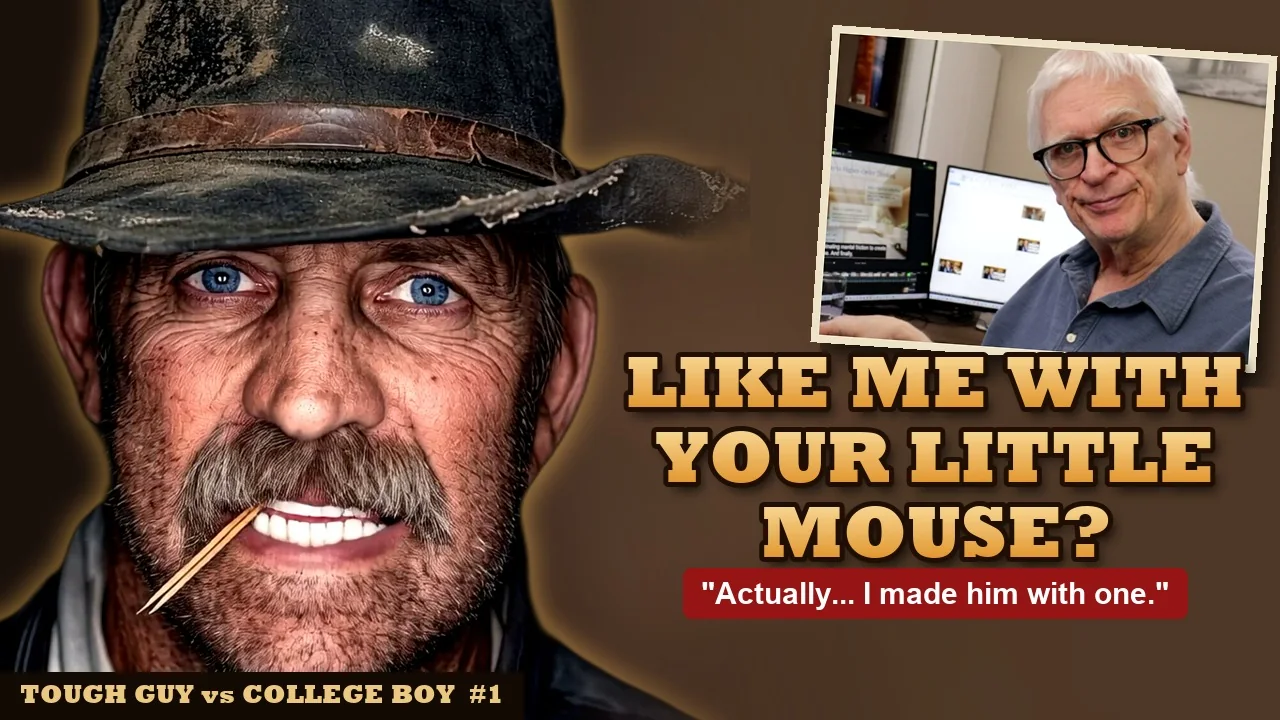
Episode 01 · The opening showdown
LIKE ME WITH YOUR LITTLE MOUSE?
Tough Guy sizes up that “tiny little college boy” with all his computer screens, books and degrees, then mocks his tiny little computer mouse. College Boy has one quiet reply: he made Tough Guy with it.
Behind the scenesCharacter creation, visual consistency and the peculiar relationship between an AI-assisted character and his creator.
How it was made
The jaw harp and harmonica were generated with ElevenLabs sound effects. My tension chords build toward the climax from a progression worked out with ChatGPT. And yes, “Yippee-ki-yay” is a tip of the hat to Bruce Willis in Die Hard.
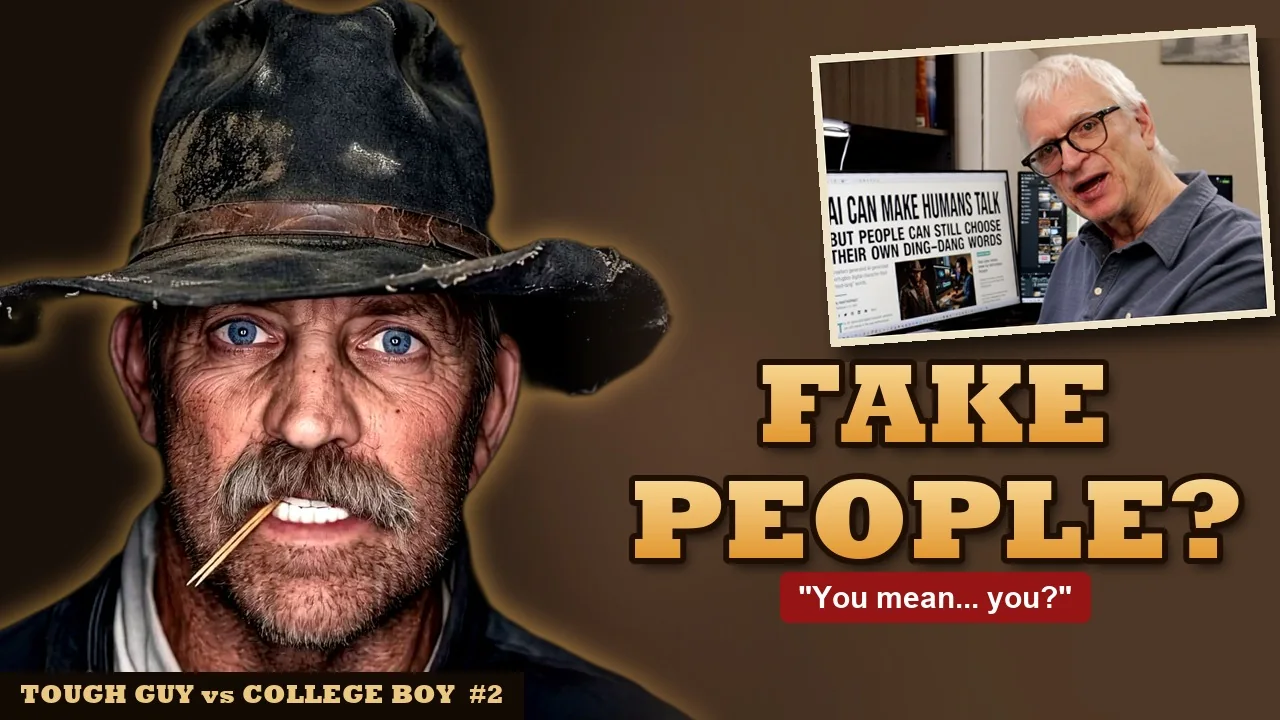
Episode 02 · An identity crisis, Western-style
FAKE PEOPLE?
Tough Guy scoffs at College Boy for making fake people with artificial intelligence. College Boy gently points out that Tough Guy’s face, voice and moving lips all came from AI tools. Tough Guy remains unconvinced, and insists he still has more manly charisma than any training video.
Behind the scenesAI-generated faces, synthetic voices and avatar lip-sync, and why the human storyteller still needs to stay visible.
How it was made
I heavily rewrote the ChatGPT draft so College Boy could point out that Tough Guy is assembled from a whole stack of AI tools. My tension chords cut off abruptly on “high horse.” For the closing shot, Google Flow first put Tough Guy’s face onto a wooden rocking horse, then animated him rocking and scowling at the camera. And “Know what I mean?” is a nod to Jim Varney’s Ernest P. Worrell, minus the “Vern.”
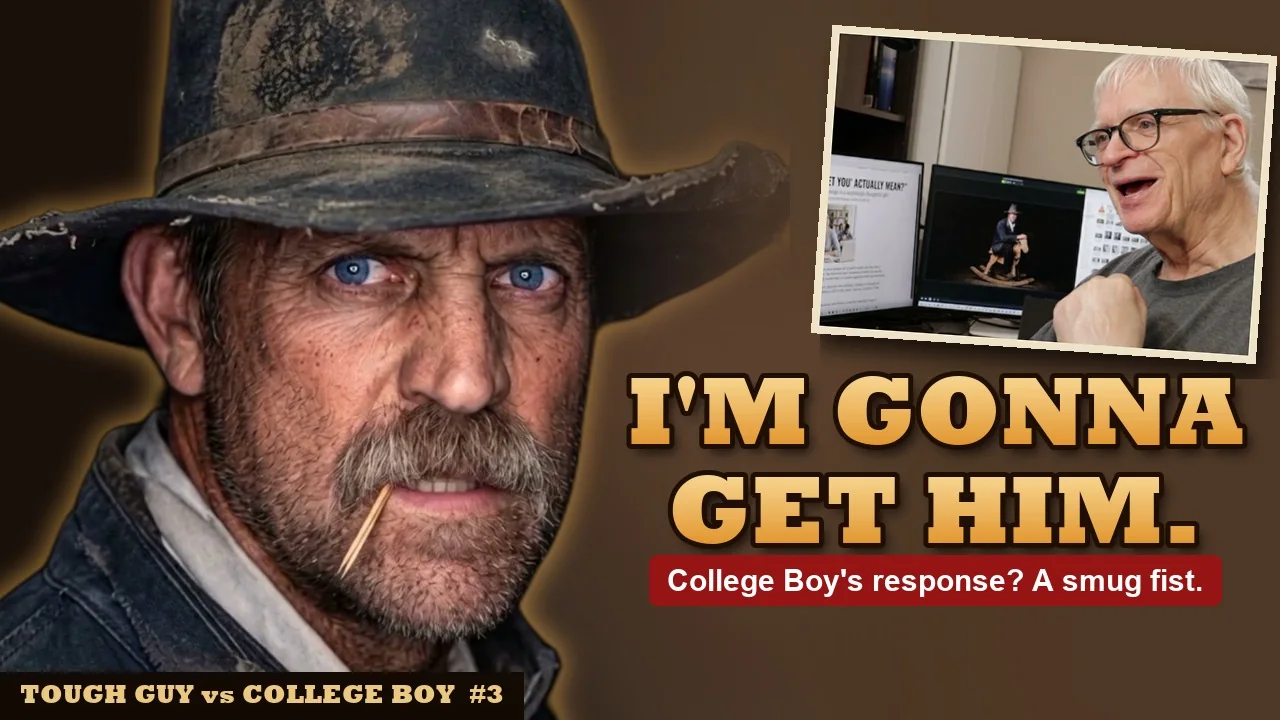
Episode 03 · A threat, gift-wrapped
I’M GONNA GET HIM.
Tough Guy vows to get even with College Boy. College Boy, entirely unbothered, simply wonders what Tough Guy is going to get him.
Behind the scenesComic contrast and reaction timing in a thirty-second short, where one smug fist says more than a monologue.
How it was made
This script is entirely my own, drawn from my years teaching in Red Deer, Alberta. A student once told me, “I’m gonna get you.” When I told a colleague, she laughed and asked, “What’s he going to get you?” That joke stayed with me for years before it landed here, with me musing over the question while Tough Guy fumes.
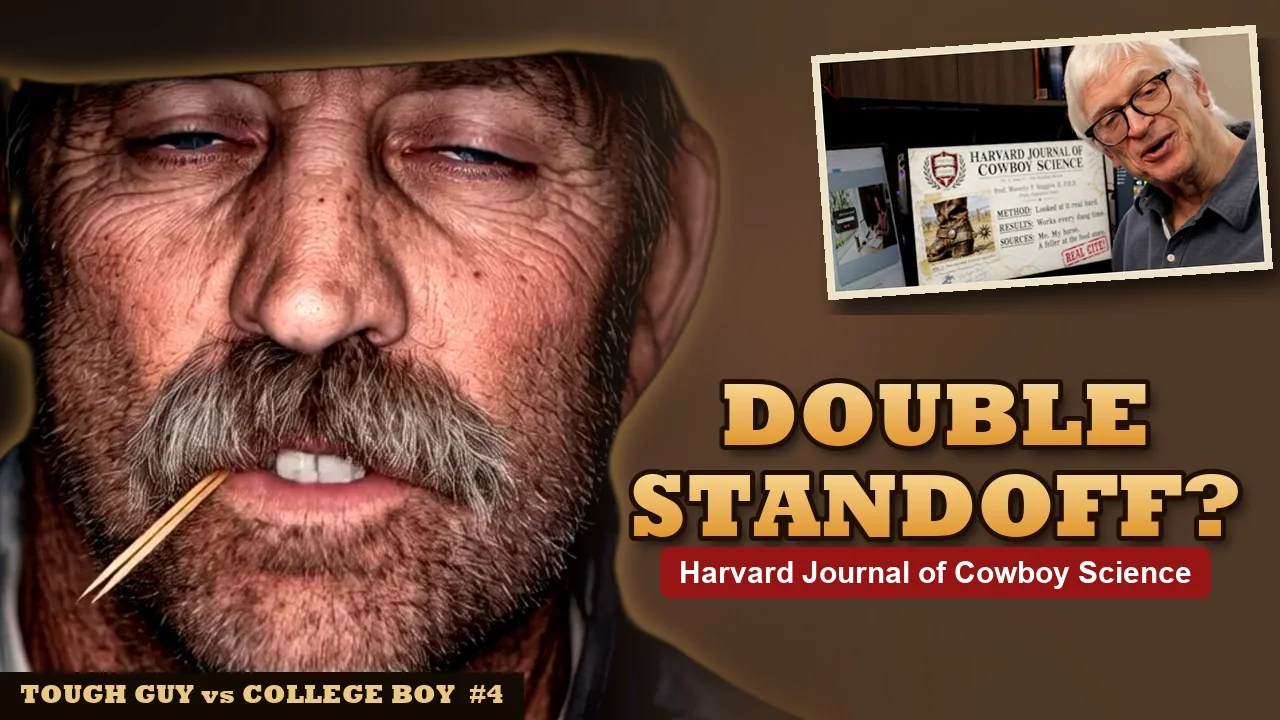
Episode 04 · The cowboy science problem
DOUBLE STANDOFF?
Tough Guy backs up his claims with the Harvard Journal of Cowboy Science. College Boy points out that it doesn’t exist. Tough Guy’s rebuttal: College Boy made him up, so isn’t that what fancy-pants book learners call a double standoff?
Behind the scenesParody, invented citations and using familiar academic conventions for comic effect.
How it was made
Another heavy rewrite of the ChatGPT draft. The “double standoff” (Waverly meant “double standard”) is my addition. The rattlesnake rattle was generated with ElevenLabs, and the howling wind came from a sound-effects library. The escalating threats are a nod to Chris Elliott’s “Guy Under the Seats” on Late Night with David Letterman, which itself echoed Bill Murray’s promise, as Letterman’s very first guest, to make Dave’s life “a living hell.” I’m just carrying on the tradition, if not the paycheque.
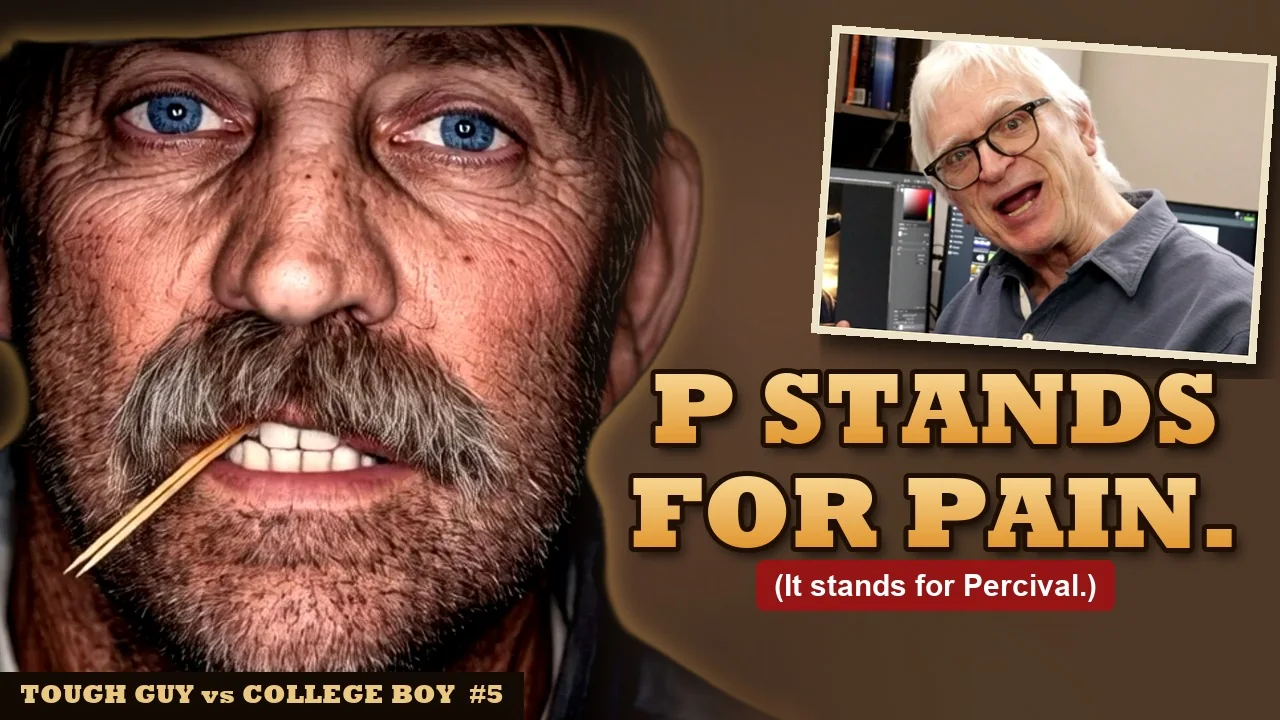
Episode 05 · A name to remember
P STANDS FOR PAIN.
College Boy opens Tough Guy’s avatar file and finds his real name: Waverly P. Huggins. The P, Tough Guy insists, stands for Pain. The file says Percival.
Behind the scenesVoice acting, character development and the comic value of revealing information at exactly the wrong moment.
How it was made
My innocent “What’s your real name?” channels Martin Short’s trademark move: fawning curiosity that sets up a deep humiliation. The name card scrolls slowly up the screen to reveal a name so gentle it undoes him: Waverly P. Huggins. The P is for Percival. I came up with “Waverly” myself at the start of a brainstorm with AI, which confirmed it was a real name. On the EZ-220 I added a thunderclap and a high harpsichord trill that rises with his anger, comically at odds with that deep, gravelly voice. The closing is my own five-note pan flute riff, a nod to classic spaghetti-Western scores.
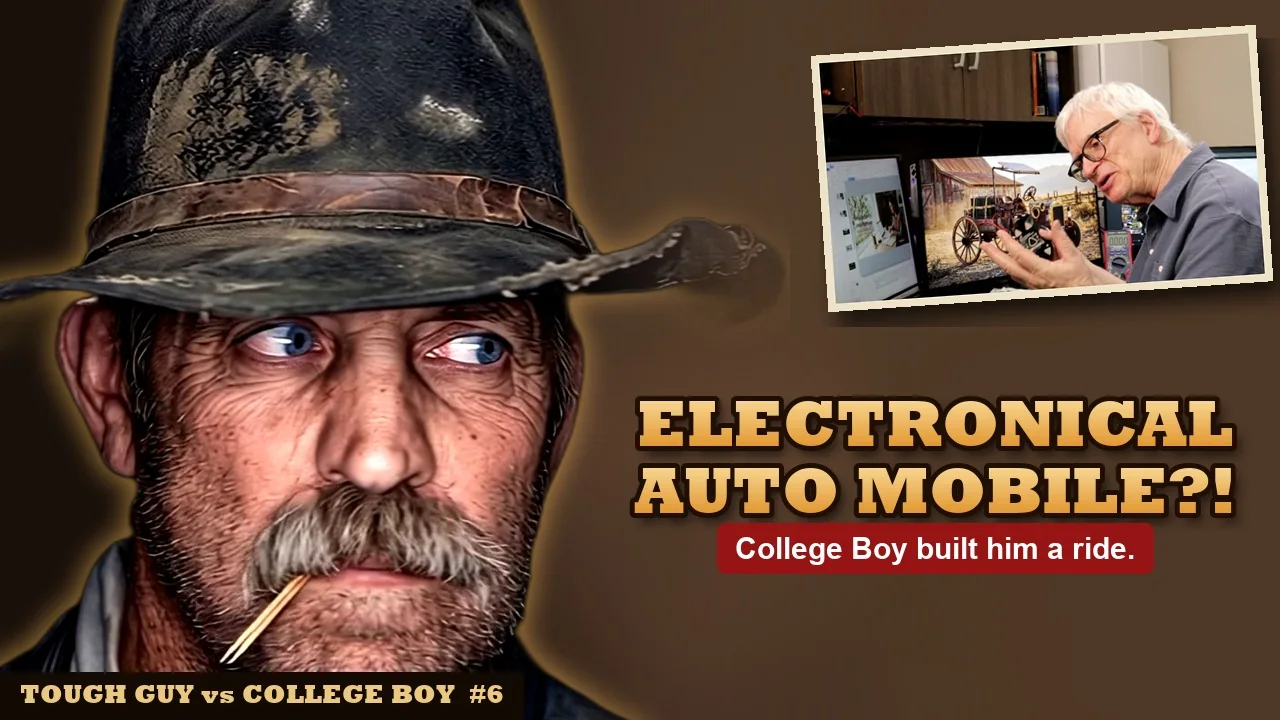
Episode 06 · An unexpected ride
ELECTRONICAL AUTO MOBILE?!
Tough Guy is certain that’s College Boy out there, showing off in his tiny little electronical auto mobile. Actually, College Boy was building one for Tough Guy, to help clean up the environment. Tough Guy has other plans, mostly involving the computer mouse and a trash bin.
Behind the scenesScene design, character reactions and making an absurd technical premise visually legible.
How it was made
I wrote this script after a walk with my wife, when the hum of passing electric vehicles struck me as exactly the kind of thing that would get under Tough Guy’s skin. A chip on his shoulder, and a little envy. The EV sounds came from a sound-effects library. Waverly’s opening eye movement began as a still image, animated in Google Flow’s video mode so that only his eyes move. His EV image was made with Nano Banana, Google’s image model, inside Flow. The vice grips and voltmeter on the desk are props from my tool shed, as if anyone could build an EV on a computer monitor with those. And “Stop calling me Waverly” nods to Leslie Nielsen’s “And don’t call me Shirley” in Airplane!. It also gives a glimpse of a man who has never made peace with his name.
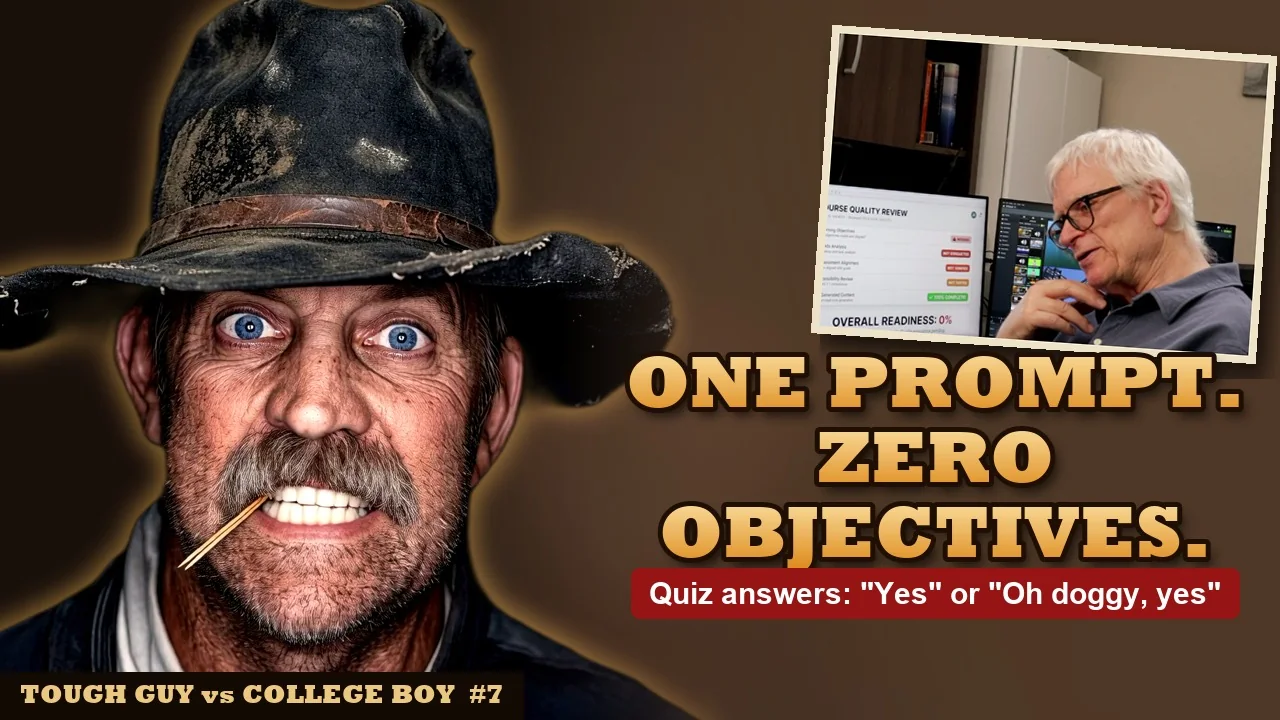
Episode 07 · The one-prompt miracle
ONE PROMPT. ZERO OBJECTIVES.
Tough Guy has found a website that turns one prompt into a whole corporate training course, complete with a quiz whose only answers are “yes” and “oh doggy, yes.” College Boy asks about learning objectives. Tough Guy points to the official certificate.
Behind the scenesAn instructional design satire about learning objectives, assessment quality and the limits of one-prompt course generation.
How it was made
This one is aimed at my own field. It skewers the instructional design “gurus” who know very little about the craft but promise you a full online course at the click of a button. The original score was composed with ElevenLabs’ Eleven Music. I wanted the solemn grandeur of a classic Western, played completely straight while Waverly does something outrageous, and after a few rounds of describing the mood, it delivered. By happy coincidence the music rises and falls with the conversation, almost as if it had been choreographed.
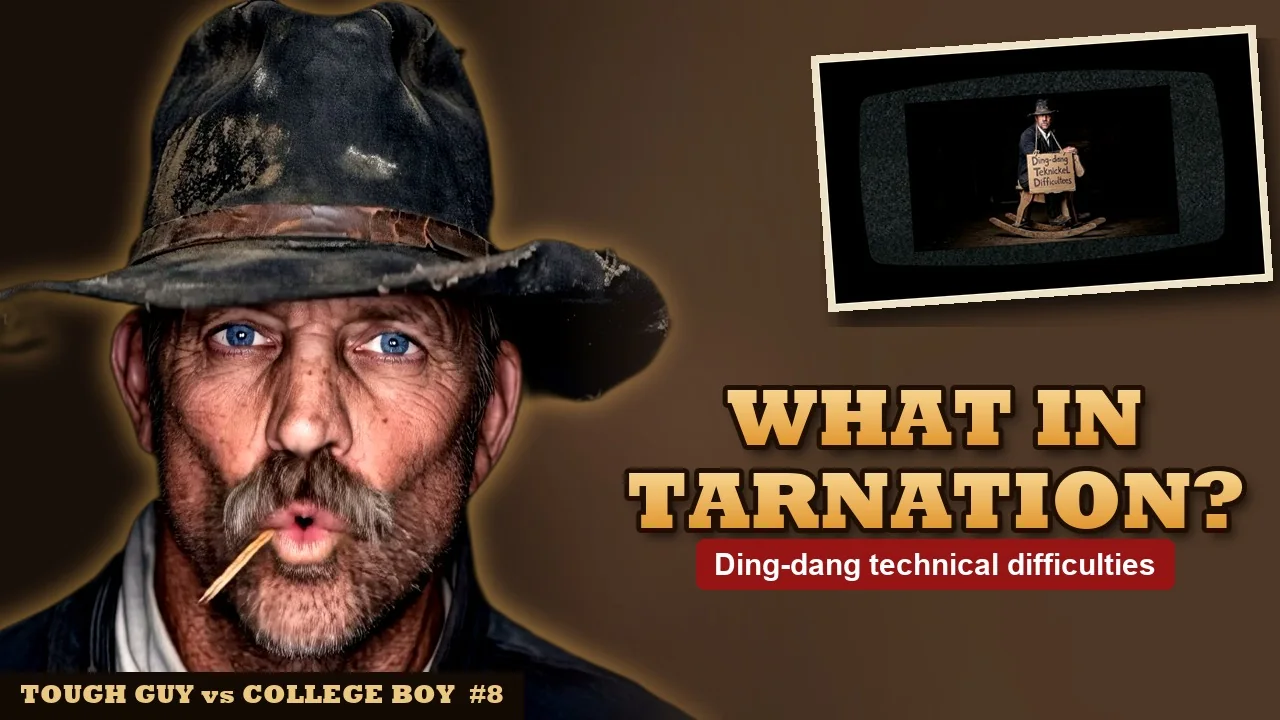
Episode 08 · Ding-dang technical difficulties
WHAT IN TARNATION?
A brand-new AI avatar arrives missing the top half of her head, and the show is forced to continue in audio only. Tough Guy is outraged. He is no gum-flappin’ radio personality; he is a larger-than-life movie star.
Behind the scenesCreative constraints, visual minimalism, troubleshooting and turning apparent defects into storytelling.
How it was made
Episode 8 wasn’t planned. It grew out of a real problem. A couple of my avatar generations on an AI avatar platform failed, including one that rendered a woman with the top of her head missing, and support was slow to respond. ChatGPT and I decided to turn it into an episode, because this is everyday reality for instructional design teams working with AI. That’s why the screen goes black early and stays black: the show carries on in audio only, just as a real project has to when the tools let you down.
Sound became part of the writing
Rhythm can carry the emotional turn.
The jaw-harp passage in the series is not really melodic. It works through rhythm: odd and comic at first, then increasingly unsettling as tempo and volume rise. The same sonic material changes emotional meaning without needing additional dialogue.
That discovery opens a larger production path: keyboard, electronic drums, rhythm, silence, stings, and recurring character cues can become part of the design rather than decoration added at the end.
Why this matters for learning design
Timing is instructional. A pause can make a learner notice. A rhythmic escalation can signal that an assumption is becoming absurd. A short sonic cue can create continuity across a series. These are small production choices, but they influence attention and interpretation.
What I’m learning
A reusable microlearning pattern is emerging.
Tough Guy & College Boy can be useful wherever a short contrast is more effective than another explanatory paragraph: onboarding, cybersecurity, compliance, customer service, leadership, inclusion, or technology adoption.
The characters do not need to carry the lesson. Their job may simply be to surface the misconception, earn attention, create a memorable contrast, and hand the learner back to the real learning activity.
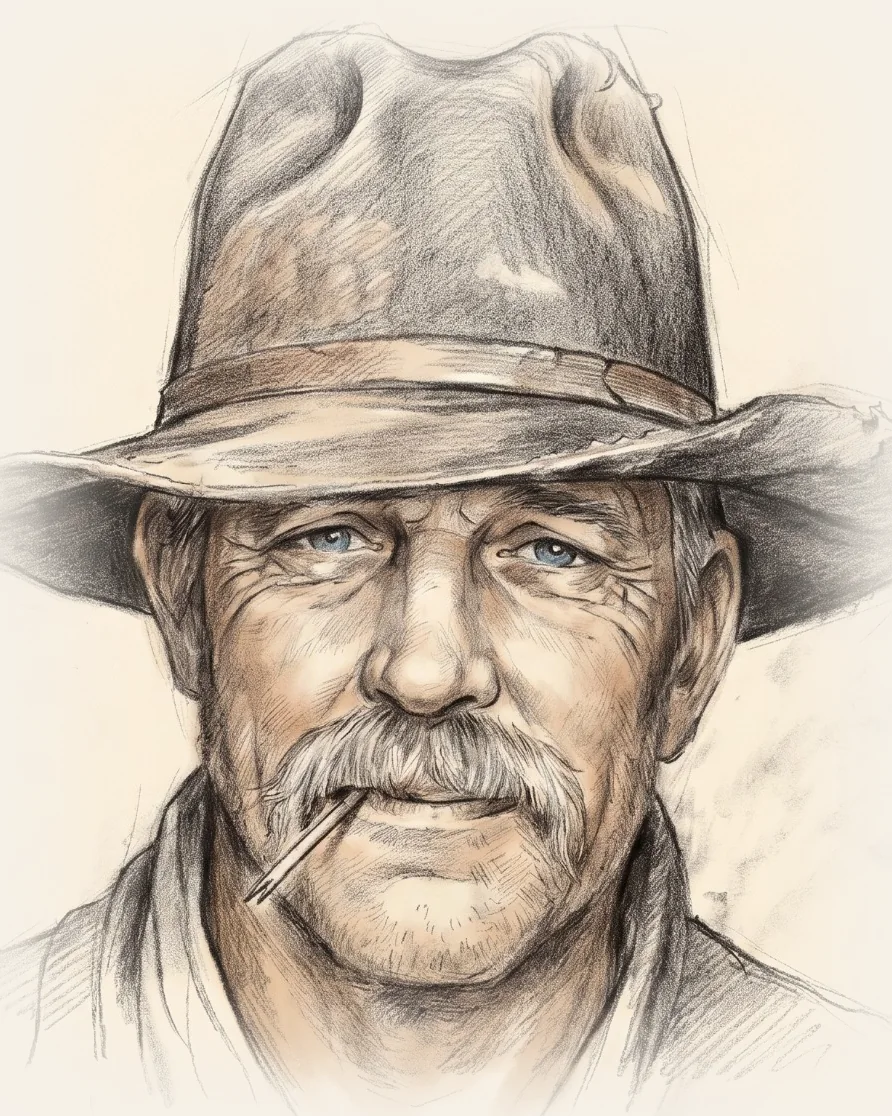
About Waverly
More than a punchline.
Waverly is played for laughs, but he isn’t just a punchline. I wanted him to have depth, because in my experience people with hard edges usually have reasons for them. As someone who lives with complex PTSD, I’ve come to feel real empathy for him.
His bluster, his chip on the shoulder and his sore spot about his own name all come from somewhere. I hope viewers find a little of that empathy too. I’m a strong advocate for open, honest conversation about mental health, and this character is one small way of having it.
About the production
Not a one-prompt miracle
These films combine human-written comic ideas with AI-assisted visual and voice production, iterative prompting and hands-on editing. Some of the funniest moments emerged from unexpected results, and from the decisions made about whether to repair, rework or embrace them.
Purpose → Prototype → Direct → Edit → Evaluate → Iterate
The interesting part is not what AI can generate. It’s what gets selected, rejected, rewritten, redirected, shortened, performed, edited and finally judged worth showing.
AI in Practice
Back to the living design laboratory.
Explore the other experiments, featured projects, and emerging techniques.