Featured Case Study · Corporate eLearning
Understanding Unconscious Bias
Turning a fifteen-second anecdote into the moment a learner catches their own bias in the act.
ROLE
Instructional designer — creative architect, media production, narration
CONTENT AUTHOR
Alden E. Habacon
BUILD TOOLS
TechSmith Camtasia · Articulate Storyline 360 · SCORM 1.2
FULL MODULE
35–40 minutes, four sectionsbe
A collaboration, and how it worked
The Inclusion & Diversity series was authored by Alden E. Habacon — Director of Intercultural Understanding Strategy Development at the University of British Columbia, formerly Manager of Diversity Initiatives at CBC Television, founder of Inclusive Excellence Strategy Solutions, and a recipient of the Queen Elizabeth II Diamond Jubilee Medal for his work in multiculturalism.
Alden and his team supplied the intellectual framework: a bare-bones script, a handful of image ideas, and the subject-matter authority behind every claim in it. My work was everything between that script and a learner's screen.
Nothing was published until Alden had reviewed and approved what I had done with it. That loop was the working method, not a formality — he had entrusted personal experience to the project, and each treatment had to earn it.
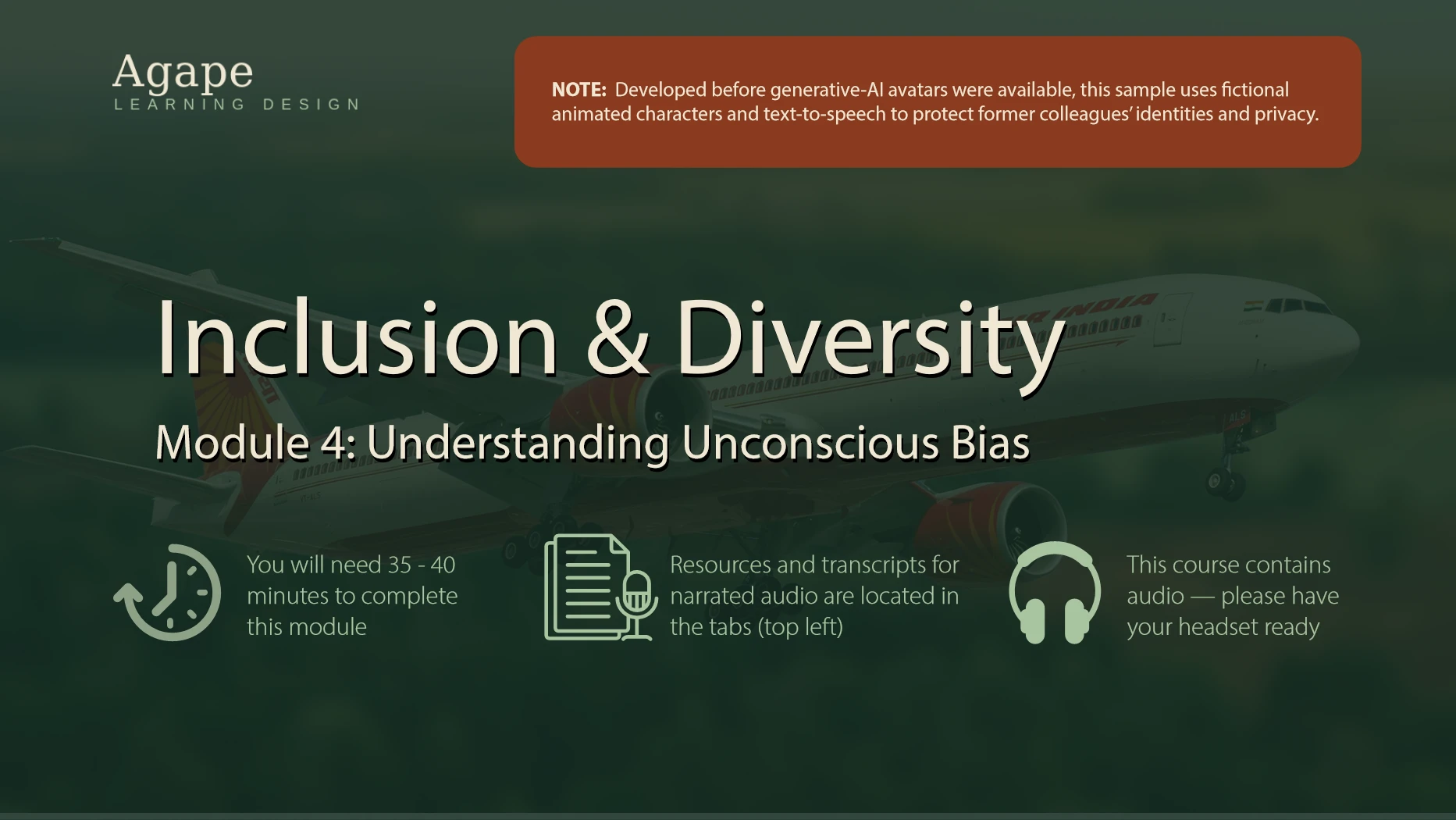
Interactive portfolio sample
Experience the learning
Try a short excerpt from the Storyline experience and see how the design moves from an apparently simple choice to reflection, explanation, and practical application.
A portfolio-safe excerpt—not the complete proprietary module.
Why Inclusion comes first
The series is titled Inclusion & Diversity, in that order, and the order is deliberate. It follows the inclusive-excellence tradition Alden helped shape in Canada: diversity describes who is present; inclusion describes whether their presence changes anything. Recruit without inclusion and you have produced a headcount, not a culture — and usually a retention problem eighteen months later.
This distinction shaped the module more deeply than any single technique because, for Alden, it was not merely theoretical. During our collaboration in 2019, he shared how, early in his career, he gradually came to recognize that—despite formal organizational commitments to inclusion—he was frequently not included in important conversations and processes. The realization was painful, but it also gave personal urgency to the work he would go on to do: helping organizations understand that representation without meaningful participation is not inclusion.
The design problem
Unconscious bias training has one of the weaker evidence records in corporate learning, and the failures are well documented. Frank Dobbin and Alexandra Kalev found that mandatory diversity training frequently produces backlash rather than change, particularly when framed around legal liability. Patrick Forscher's meta-analysis examined 63 studies linking shifts in implicit-bias measures to shifts in behaviour and found no evidence of a causal chain. You can move the score without moving the conduct.
So the problem wasn't “teach people about bias.” It was: build the intervention type the literature says usually fails, in a way that avoids the specific mechanisms by which it fails.
Bias in itself doesn't make you a bad person. It's just the knee-jerk reaction of your unconscious.Module narration, Section 1
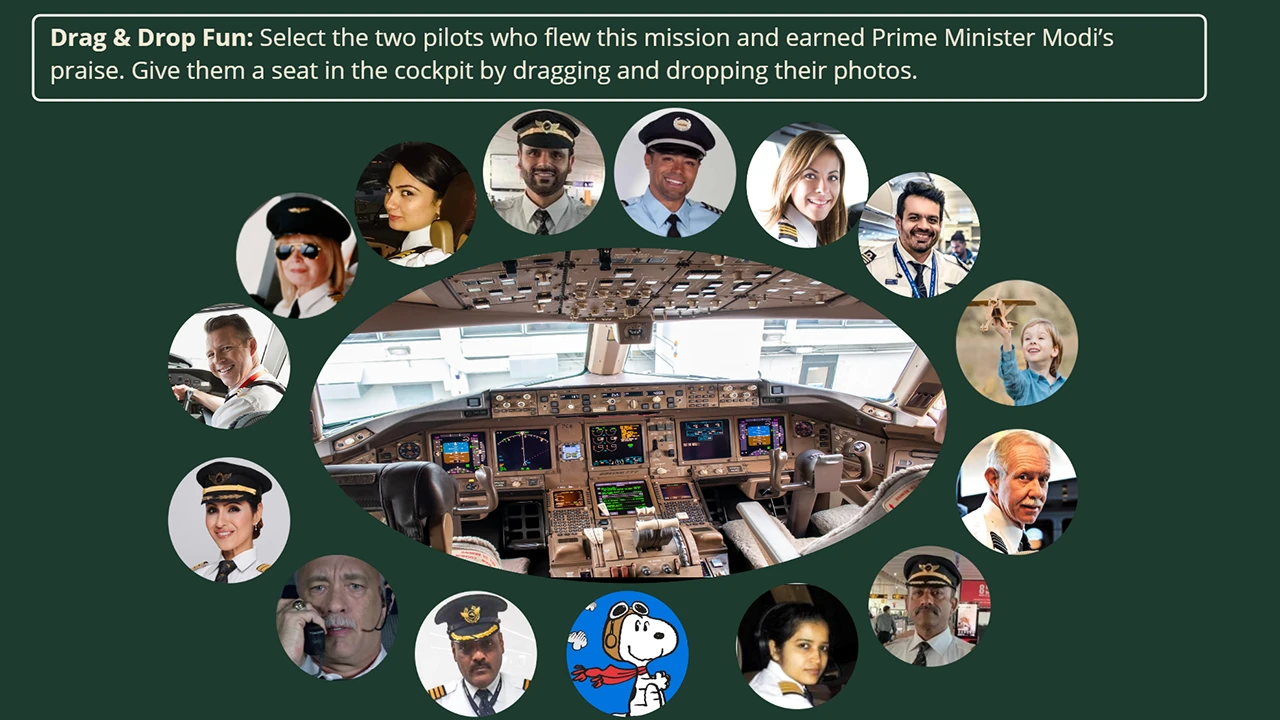
Figure 1 — the interaction as built
Learners are asked to seat the two pilots who flew the mission. The choice is made before any explanation is offered, which is what makes the reveal land as self-detection rather than instruction.
From anecdote to instrument
In the source script, the Air India story was a fifteen-second narrated aside. On 22 March 2020, an Air India crew repatriated 263 people stranded in Rome during the first COVID lockdowns, and Prime Minister Narendra Modi publicly praised them. Told, and moved past.
I recognised something else in it. The story contains a gap the learner's brain fills automatically — and filling it is the lesson. So I rebuilt it as a commit-then-reveal interaction: picture the crew, seat two pilots, and only afterward meet Captain Swati Raval, the first Indian woman to command a pandemic rescue flight.
Nobody is told they hold bias. They watch themselves demonstrate it, then receive an explanation for why it happened. Self-detection survives the defensiveness that instruction triggers.
The lineup itself was engineered rather than assembled. This was built before generative AI, so every candidate was researched and sourced by hand, and each position does a specific job.
Figure 2 — why the lineup is calibrated this way
The Red Baron isn't a joke at the learner's expense. A lineup of only plausible candidates reads as a test, and people answer tests defensively. Snoopy signals play, lowers the stakes, and makes being wrong survivable — which has to be true before the reveal, or the reveal produces shame instead of insight. It does the same work as the “doesn't make you a bad person” line in the narration, visually, and thirty seconds earlier.
Four further decisions
Dual-process framing, not implicit-association testing
Bias is framed through Kahneman's System 1 and System 2 — fast intuition versus deliberate reasoning. Learners never take an IAT and are never given a score. Bias is presented as an architectural feature of fast cognition, which is well supported, rather than as a personal measurement, which is not.
Blame removed, deliberately and repeatedly
After the reveal the narration says that choosing a male or Caucasian pilot “doesn't necessarily make you sexist” and “doesn't make you a bad person,” and later that “surprise would be a normal response.” The reassurance sits at the precise moment defensiveness would set in. Nothing in the script uses compliance or liability framing.
Situational vulnerability over trait awareness
The module teaches learners to identify when they are most vulnerable, not merely that they are. The Reflection Guide asks what would change about the hours beforehand — more to eat, better sleep, not reading email first. That's decision hygiene, and it gives learners a lever they can pull.
Six disruption techniques, ranked by difficulty
The objectives end in practice rather than insight: six named techniques for interrupting bias in the moment, plus giving and receiving feedback in a team. Learners rank the six by how hard each would be for them personally, surfacing which behaviours they'll realistically adopt.
Designed against the evidence
Known failure modes, treated as design constraints
Bias training fails in documented, specific ways. Each one became a requirement rather than a risk.
Dobbin & Kalev, Why Diversity Programs Fail, Harvard Business Review (2016) · Forscher et al., A Meta-Analysis of Procedures to Change Implicit Measures, JPSP (2019) · UK Equality & Human Rights Commission, Unconscious Bias Training: An Assessment of the Evidence for Effectiveness (2018) · Kahneman, Thinking, Fast and Slow (2011)
Duty of care
Alden shared deeply personal aspects of his own life with me, and then trusted me to shape them into something learners could receive. That trust set the constraints for the whole build.
- ▸Animated characters and text-to-speech replace real footage and voices, specifically to protect the identity and privacy of former colleagues whose workplace experiences informed the content — disclosed to learners openly on screen rather than concealed.
- ▸Trauma-informed pacing. Difficult material is preceded by an explanation of the mechanism and followed by an exit that doesn't leave the learner sitting in shame.
- ▸The narrator models the correction. Rather than lecturing, the narration includes a first-person admission about having been taught a sanitised version of Canada's residential schools — the designer demonstrating the same pattern-revision being asked of the learner.
- ▸Territorial acknowledgment of the Coast Salish peoples, delivered as substance within the module rather than as preamble to it.

Figure 3 — faceless by design
Whiteboard animation carries the segments dealing with lived experience. The figures are deliberately unfeatured, so learners project rather than categorise — and so no real person is depicted in material about bias.
Build and transfer
Three artifacts sit in the Resources tab and outlive the session: a stated Objectives sheet, a five-activity Reflection Guide learners write into as they go, and a Bias Types Cheat Sheet covering affinity, confirmation, racial, fundamental attribution and distance bias, plus three biases with documented disparate impact on women and on Black, Indigenous and racialised colleagues — performance attribution, the competency–likeability trade-off, and maternal bias.
Instructional craft
- ▸Generation effect, used correctly. The influential-patterns segment stops and instructs learners to pause, write their own list, then restart and compare against four common sources. Retrieval before exposure, not after.
- ▸Executive sponsorship, then handoff. The Chief People and Culture Officer opens the module and explicitly transfers narration to me by name. Authority is established, then the register shifts to peer.
- ▸Accessibility. Full transcript tab and mute control announced up front, so the module is completable entirely by reading. Alt text throughout. Runtime and audio requirement disclosed before learners commit.
What I would change
The module's limit is the one the research keeps flagging across the whole category: it ends at the individual. Dobbin and Kalev's stronger findings are structural — social accountability through published outcome data, voluntary rather than mandated participation, cross-group contact, mentoring, named ownership. Those levers belong to the organisation, and no module pulls them alone.
Given a second engagement I would pair this with a manager-level companion tied to hiring panels, promotion calibration and performance-review language — the decision points where bias converts into outcome. The individual module raises the odds those conversations land. It cannot substitute for them, and shouldn't be sold as though it can.
This module exists because of the work and the trust of
Alden E. Habacon
whose thinking on inclusive excellence shaped a generation of practice in Canada, and who made this material better than I could have made it alone.
THE CHOICE IS YOURS
Possible Next Steps